


Syllabus: GS3/ Science and Technology
Context
- Over the last twelve years, India’s space programme has emerged as a symbol of national confidence, technological self-reliance, and global ambition.
The Rise of a Global Space Power
- India’s space economy is currently valued at $8 billion with a share of 2–3% in the global space economy.
- It is projected to grow five-fold to $40–45 billion over the next decade, with its global share targeted at 8% by 2030.
- India has achieved self-reliance in space transportation systems to launch satellites up to 10 tons to Low Earth Orbit (LEO) and 4.2 tons to Geo-Synchronous Transfer Orbit (GTO) through the currently operational PSLV, GSLV and LVM3 launch vehicles.
Lunar Exploration – The Chandrayaan Programme
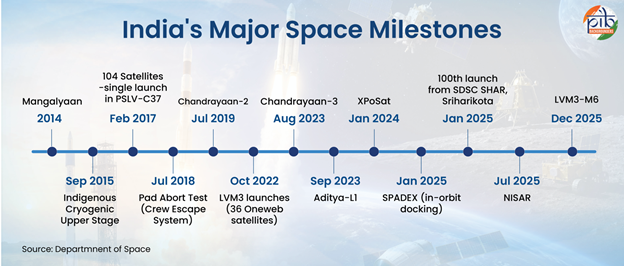
- The foundation of India’s lunar journey was laid with Chandrayaan-1 in 2008, India’s first mission to the Moon.
- The mission discovered evidence of water molecules and hydroxyl on the Moon’s surface. Further, Chandrayaan-2, launched in 2019, strengthened India’s lunar programme.
- On 23 August 2023, Chandrayaan-3 made India the first country to achieve a soft landing near the Moon’s south pole and the fourth nation after the United States, Russia, and China to successfully soft-land on the lunar surface.
The Mars Orbiter Mission (Mangalyaan)
- On 24 September 2014, Mangalyaan successfully entered Martian orbit, making India the first country to reach Mars on its maiden attempt.
- With this achievement, ISRO became only the fourth space agency in the world to place a spacecraft in orbit around Mars after United States’ NASA, Russia’s Roscosmos, and the European Space Agency (ESA).
Aditya-L1: India’s First Solar Observatory
- Launched in 2023, the spacecraft was successfully placed in a halo orbit around the Sun-Earth L1 Lagrange Point, nearly 1.5 million kilometres from Earth.
- The mission studies the solar corona, solar winds, and space weather phenomena that influence Earth’s environment and technological systems.
Space Astronomy and Space Docking
- AstroSat, India’s first multi-wavelength space observatory, completed a decade in orbit in September 2025 and has contributed several important scientific discoveries.
- XPoSat, launched in 2024, further expanded India’s capabilities in X-ray astronomy.
- The Space Docking Experiment (SPADEX) made India the fourth nation after the United States, Russia, and China to demonstrate autonomous docking and undocking in space.
Venus Orbiter Mission
- The Venus Orbiter Mission, approved by the Government of India, is targeted for launch in 2028.
- The mission will study Venus’ geology, surface composition, atmosphere, ionosphere, and resurfacing processes.
Gaganyaan: India’s First Human Spaceflight Programme
- The mission aims to send up to three Indian astronauts into a 400-kilometre orbit for up to three days before bringing them safely back to Earth. The programme includes two uncrewed missions and one crewed mission.
- India participated in the ISRO-NASA supported Axiom-4 mission to the International Space Station in 2025.
- Group Captain Shubhanshu Shukla travelled aboard the SpaceX Dragon spacecraft launched by Falcon 9 in 2025.
National Space Station
- Bharatiya Antariksh Station (BAS) is India’s planned space station and a key pillar of Space Vision 2047.
- BAS will be a five-module space station in Low Earth Orbit, designed to support long-duration human space missions and advanced scientific research in microgravity.
Reusable Launch Vehicles (RLV)
- ISRO’s RLV-TD programme marks a major step towards low-cost and reusable space transportation systems.
- ISRO successfully flight-tested RLV-TD in 2016 from SDSC SHAR, Sriharikota, validating autonomous navigation, guidance and control systems, reusable thermal protection systems, and re-entry mission management technologies.
Indigenous Electronics and On-board Systems
- ISRO jointly with Semiconductor Laboratory (SCL), Chandigarh developed VIKRAM3201, India’s first fully indigenous 32-bit space microprocessor, along with KALPANA32 for high-reliability space missions.
- This reduces dependence on foreign components and improves mission safety.
NavIC – India’s Indigenous Navigation System
- It provides accurate positioning, navigation, and timing services across India and up to 1,500 kilometres beyond its borders.
- The system operates through a constellation of satellites providing continuous regional coverage.
Private Sector Powering India’s Space Transformation
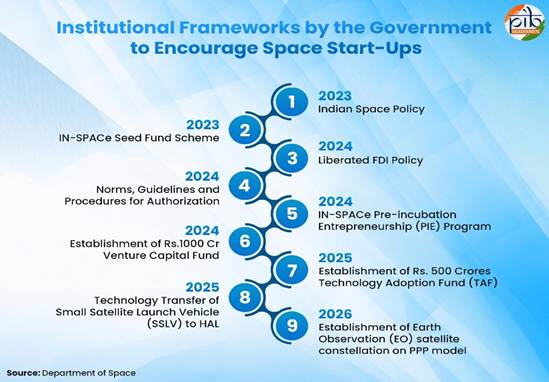
- The opening of the space sector for private players in 2020, followed by the Indian Space Policy 2023, enabled greater private participation across the space value chain.
- In 2024, the Government liberalised the Foreign Direct Investment (FDI) policy for the space sector, allowing up to 100% FDI in selected activities.
- Up to 74% FDI is permitted under the automatic route for satellite manufacturing and operations, satellite data products, and ground/user segment services.
- Up to 49% FDI is allowed for launch vehicles, related systems, and spaceports, while 100% FDI under the automatic route is permitted for manufacturing satellite and ground-segment components and subsystems.
- Companies such as Pixxel, Dhruva Space, Skyroot Aerospace, Agnikul Cosmos, and Bellatrix Aerospace have emerged as pioneers of a new space era.
Expanding India’s Space Economy
- India leads the BIMSTEC Space Programme as part of its “Neighbourhood First” policy.
- The North Eastern Space Applications Centre (NESAC) conducts specialised training programmes for BIMSTEC countries in space applications and satellite technologies.
- IndThe initiative strengthens regional cooperation through space technology, disaster management, and capacity building.
- India-Russia Partnership: Building on decades of space cooperation, ISRO and ROSCOSMOS signed an MoU in 2018 to support the Gaganyaan mission.
- India’s expanding global partnerships are also reflected in the TRISHNA (Thermal InfraRed Imaging Satellite for High-resolution Natural Resource Assessment) mission, being jointly developed by ISRO and the French space agency CNES.
Challenges in India’s Space Sector
- Competition and Global Market Share: To achieve this ambitious goal of 8% of the global market share, Indian space companies must compete effectively on the international stage.
- Technology Development and Innovation: Developing cutting-edge technologies, such as reusable launch vehicles, miniaturized satellites, and advanced propulsion systems, requires substantial investment and research.
- Regulatory Framework and Licensing: Navigating licensing processes, export controls, and compliance can be complex.
- Infrastructure and Facilities: Developing and maintaining such infrastructure requires significant capital.
Concluding remarks
- Over the last twelve years, India’s space programme has evolved into a key driver of national development, supporting governance, economic growth, and public welfare through indigenous innovation.
- As the country moves towards Space Vision 2047, it seeks to further strengthen self-reliance, scientific progress, and societal development through space-led innovation.
Source: PIB
Previous article
Essential Upgrades to India’s Statistical Databases
